
Adams Falcons
History of FalconryHistory of Falconry
Falcons are birds of prey in the genus Falco, which includes about 40 species. Falcons are widely distributed on all continents of the world except Antarctica, Adult falcons have thin, tapered wings, which enable them to fly at high speed and change direction rapidly. Fledgling falcons, in their first year of flying, have longer flight feathers, which make their configuration more like that of a general-purpose bird such as a broad-wing. This makes flying easier while learning the exceptional skills required to be effective hunters as adults.The largest falcon is the gyrfalcon at up to 65 cm in length. The smallest falcon species is the Pygmy falcon which measures just 20 cm. As with hawks and owls, falcons exhibit sexual dimorphism, with the females typically larger than the males, thus allowing a wider range of prey species.
As is the case with many birds of prey, falcons have exceptional powers of vision; the visual acuity of one species has been measured at 2.6 times that of a normal human.The Peregrine falcons have been recorded diving at speeds of 200 miles per hour (320 km/h), making them the fastest-moving creatures on Earth. The fastest recorded dive for one is (Peregrine 390 kilometers per hour (240 mph).
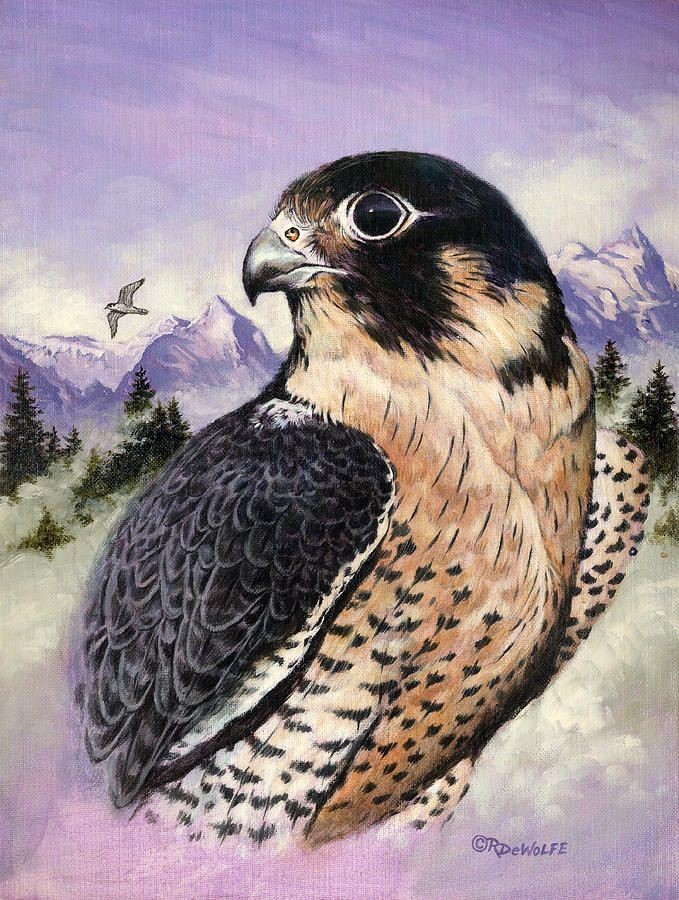
Falcons are birds of prey found on all continents in the world except for Antarctica. Like many birds of prey, falcons have exceptional powers of vision and, as such, are lethal predators.
Racing falcons in the middle east is a very important part of their culture, it is said that the SaudiPrince has 86 Gyr-Saker falcons.
Evidence suggests that the art of falconry may have begun in Mesopotamia, with the earliest accounts dating to around 2,000 BC. Also, some raptor representations are in the northern Altai, western Mongolia.The falcon was a symbolic bird of ancient Mongol tribes.
Historically, falconry was a popular sport and status symbol among the nobles of medieval Europe, the Middle East, and Mongolian Empire. Many historical illustrations left in Rashid al Din’s “Compendium chronicles” book described falconry of the middle centuries with Mongol images. Falconry was largely restricted to the noble classes due to the prerequisite commitment of time, money, and space. In art and other aspects of culture, such as literature, falconry remained a status symbol long after it was no longer popularly practiced. The historical significance of falconry within lower social classes may be underrepresented in the archaeological record, due to a lack of surviving evidence, especially from nonliterate nomadic and nonagrarian societies. Within nomadic societies such as the Bedouin, falconry was not practiced for recreation by noblemen. Instead, falcons were trapped and hunted on small game during the winter to supplement a very limited diet.
In the UK and parts of Europe, falconry probably reached its zenith in the 17th century, but soon faded, particularly in the late 18th and 19th centuries, as firearms became the tool of choice for hunting. (This likely took place throughout Europe and Asia in differing degrees.) Falconry in the UK had a resurgence in the late 19th and early 20th centuries when a number of falconry books were published. This revival led to the introduction of falconry in North America in the early 20th century.
Falconry is not a museum piece, it is alive. We can enjoy and promote all the best of modern falconry and support its traditional forms as well. We must protect and promote these vulnerable, minority aspects and practices of falconry as precious embodiments of world cultural history. The project to have aspects of falconry recognised by UNESCO encourages research into the social history of falconry, enriches the historical consciousness of falconers and promote and safeguard falconry for future generations.
Our Specialties
We Can Do It All. Get In Touch For a Free Consultation
+44 790 8888 344
info@adamsfalcons.co.uk