
Adams Falcons
Arab FalconryArab Falconry
Falconry appeared with the emergence of civilizations and was already popular in the Middle East and Arabian Gulf region several millennia BC.
In the Al Rafidein region (Iraq) it was widely practiced 3500 years BC; in 2000 BC the Gilgamesh Epic clearly referred to hunting by birds of prey in Iraq.
The Babylonians created a Divan for falcons and made game reserves for quarry species. Al Harith bin Mu’awiya, an early King of the present region that includes Saudi Arabia, was one of the first who trained and hunted falcons. The Omayyad caliphs and princes, Mu’awiya bin Abi Sufyan and Hisham bin Abdul Malek, practiced falconry and falconry had a good position in the Abbasid period. The caliph Haroun Al Rasheed was fond of the sport and exchanged falcon-gifts with the other kings.The Arab poets composed a lot of poems lauding the falcon and all Arab classes – Kings, Sheikhs and cavalry – practiced falconry and bequeathed it to the next generations. The Arabian Gulf region became famous for its falconers and falconry traditions.
Through Arab influence it spread out through the Islamic World, eastwards into the great Islamic Empires of Central Asia and westwards across North Africa to the Magreb, giving us the distinctive styles of falconry of the Bedouin.
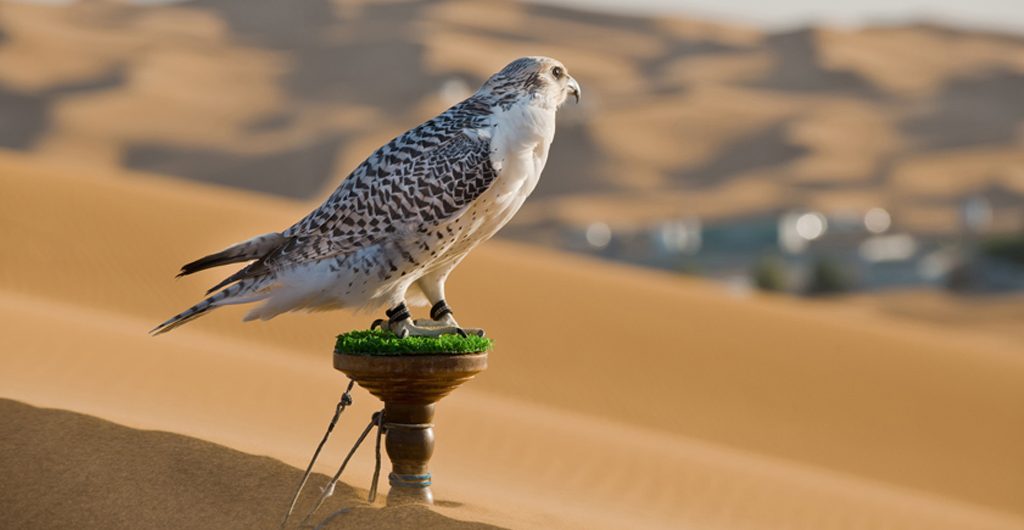
Falconry is considered a symbol of this region’s civilization more than any other region in the world; 50% of the world’s falconers exist in the Middle East, which includes the Arab region.
In the philosophy of the region hunting trips teach patience, endurance and self-reliance and bravery can be learned from falcons.
We prefer natural breeding and we only interfere occasionally to perform artificial insemination or to pull eggs to increase our chances of a second clutch. Most of the eggs are bred within an incubator where the condition of the unborn falcons is constantly monitored. The newly born falcons are only raised by hand for the first couple of days and once they have survived this crucial period they can return to their parents where we let them grow up in a natural environment.
The process of wild hacking is very complex and it took us many years to perfect it.
Once the birds reach a certain age we have a highly selective process in order to chose which birds go into wild hacking and which ones go directly into big aviaries.
We have formulated a wild hacking process over the past 15 years. We emulate the natural processes which a wild falcon experiences to ensure a strong hunter. In their time in the wild the young birds will learn to fly, play in the wind, and perform hunting manoeuvres.
We release the falcon, so the falcon can do the flying, we try to put some energy and make his muscles strong to work good at the race,” It’s about two months until the falcon is really trained. We train them sometimes twice a day, but usually it’s once a day.
In the old way, we also train them with cars, chasing the car. I put my hand outside the window and the bird is following me. So, I go by two, three or four kilometres and it’s enough. Sometimes, a good falcon can go six or eight kilometres, just chasing the car at almost 90 kph. We say it’s about two months before a falcon is ready, but we keep on training until the last race, it’s almost six months. That’s a season for.
Our Specialties
We Can Do It All. Get In Touch For a Free Consultation
+44 790 8888 344
info@adamsfalcons.co.uk